

Penn State Separator series · Refusals
TMR sorting happens when cows pick some particles out of the TMR and reject others, usually favoring the fines and the concentrate and leaving the long forage behind. As a result, the ration they actually eat is not the one that was formulated. To find out whether this is happening on your dairy, run the freshly delivered TMR and the refusals through the Penn State Particle Separator: a difference of more than 5 percentage points on any tray indicates sorting.
Content source: this article was built from answers given by the Ruminants.ai app on TMR sorting, based on the references listed at the end. It is part of the Penn State Separator series, which starts with the reference ranges your TMR should follow.
Why sorting matters
In the rumen. A cow that sorts eats more fermentable carbohydrate and less physically effective fiber than the nutritionist planned. The risk is a drop in pH and subclinical acidosis (Miller-Cushon & DeVries, 2017). In DeVries et al. (2008), cited in that review, the cows that refused the most long particles (over 19 mm) had the lowest maximum rumen pH.
In the pen. Cows that eat later find refusals that are more fibrous and less nutritious. This hurts submissive cows, first-lactation heifers and lame cows, which tend to reach the bunk later (Miller-Cushon & DeVries, 2017; Hosseinkhani et al., 2008).
In the bottom line. In commercial herds, feed efficiency dropped 3% for every 1 percentage point of over-consumption of fine particles smaller than 1.18 mm (Sova et al., 2013, cited in Miller-Cushon & DeVries, 2017).
How to measure sorting with the separator
- Sample the pen’s freshly delivered TMR and run it through the separator.
- Sample the refusals from the same pen and run them through the separator the same way.
- Calculate the percentage retained on each tray (19 mm, 8 mm, 4 mm and pan) for both samples. The free calculator in the main article does the math for you.
- Compare tray by tray.
| Difference between delivered TMR and refusals | Reading |
|---|---|
| Up to 5 points on every tray | No sign of sorting |
| More than 5 points on any tray | TMR sorting |
Rule of thumb for this series (Grant, 2026). The most common pattern is refusals that are richer in long particles and poorer in fines than the delivered TMR.
If the refusals are loaded with long particles, check the 19 mm sieve of the delivered TMR first: above 5%, the risk of sorting goes up and intake may be limited. And always repeat the test the same way, on the same pen and at the same sampling time. The value of the separator lies in the trend, not in a single reading.
What to do when cows sort
Make the TMR more uniform. Too many long particles make sorting easier; a more uniform TMR reduces the problem (Nutrient Requirements of Dairy Cattle, 8th revised ed. — Santafé edition). Check that the 19 mm sieve is within the 2–5% range and that the TMR mixer wagon is delivering the same mix along the entire bunk.
Consider liquid molasses. Liquid molasses at around 4% of DM reduced sorting (DeVries & Gill, 2012, cited in the book).
Adjust feeding management. Pushing up feed and feeding more often both help (Piran Filho, 2022).
A word on water: adding water is not an automatic fix. In a TMR that is already wet (below 60% DM), it can increase sorting and reduce dry matter intake (Miller-Cushon & DeVries, 2009).
Want to go deeper into formulating rations that cows eat the way they were designed? See the Advanced Dairy Ration Formulation and Nutrition course with Dr. Bill Weiss.
Bring the Penn State separator to your dairy
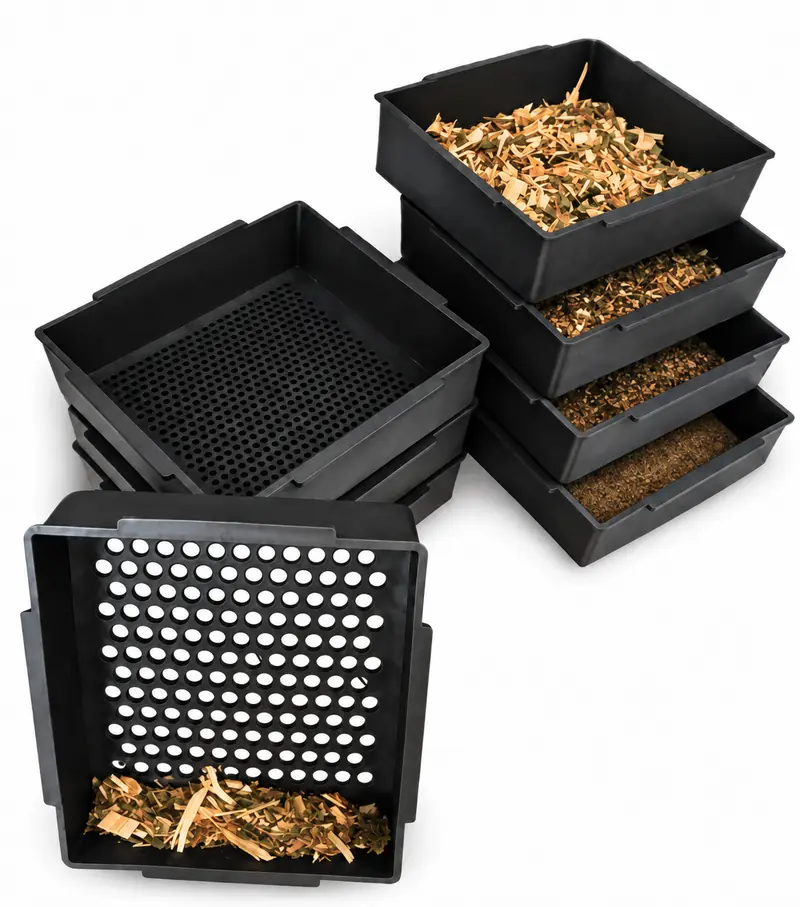
Penn State Particle Separator
3 sieves (19 / 8 / 4 mm) + closed pan · fiber-reinforced polypropylene
Get my sieve setYour separator measures. The AI interprets.
This content grew out of questions asked to Ruminants.ai. Create your account, enter the TMR and refusal weights and get the percentage on each tray, the difference between the two samples and a reading of what to check at the bunk.
Create your Ruminants.AI accountFrequently asked questions
How big a difference indicates sorting?
A difference of more than 5 percentage points on any tray between the delivered TMR and the refusals.
Does adding water to the TMR fix it?
Not always. In a TMR that is already wet (below 60% DM), water can increase sorting and reduce intake.
Which cows suffer most from sorting?
Submissive cows, first-lactation heifers and lame cows, which eat later and find refusals that are more fibrous and less nutritious.
Keep reading the series: physically effective fiber and TMR mixer wagon.
References
- DeVries; Gill 2012. Journal of Dairy Science. DOI: 10.3168/jds.2011-4965
- Grant (2026). Penn State Particle Separator sorting rule: a difference of more than 5 points between delivered TMR and refusals. Presented in Dr. Mike Hutjens’ class.
- Hosseinkhani et al. 2008. Journal of Dairy Science. DOI: 10.3168/jds.2007-0679
- Miller-Cushon; DeVries 2009. Journal of Dairy Science. DOI: 10.3168/jds.2008-1772
- Miller-Cushon; DeVries 2017. Journal of Dairy Science. DOI: 10.3168/jds.2016-11983
- Piran Filho, F. A. 2022. PhD thesis, UEM (Brazil).
- Nutrient Requirements of Dairy Cattle, 8th revised ed. — Santafé edition.