High-producing cow nutrition · Fatty acids
Fatty acids in the dairy cow diet are more than energy. Palmitic, stearic, oleic, linoleic and linolenic acid change fiber digestibility, milk, milk fat, body condition and reproduction. This guide brings together the numbers from two classes on the topic, with Jonas de Souza, PhD, and Dr. Mike Hutjens: how much to feed, which supplements work, and for which cows.
Content source: based on Jonas de Souza’s live class on dietary fatty acids (in Portuguese), Dr. Mike Hutjens’s class on fat and fatty acids on Ruminants.ai, and the review by Lock, dos Santos Neto and de Souza (2025), cited below.
From “fat” to fatty acids
For years, dietary fat was handled as a single number, ether extract, and seen only as a concentrated energy source. That view has changed. Just as nutrition moved from crude protein to metabolizable protein and then to amino acids such as lysine and methionine, fat is now read as individual fatty acids, each with its own effect on digestibility, milk, body condition and reproduction.
Five fatty acids make up about 95% of the total in any dairy cow diet:
| Fatty acid | Structure | Where it comes from |
|---|---|---|
| Palmitic (C16:0) | 16 carbons, saturated | Low in most feeds; the main fatty acid in milk. Present in the diet and also partly produced by de novo synthesis in the mammary gland |
| Stearic (C18:0) | 18 carbons, saturated | Low in the diet, but the one that reaches the intestine most, because of rumen biohydrogenation |
| Oleic (C18:1) | 18 carbons, 1 double bond | Oilseeds such as canola and high-oleic soybeans, and supplements |
| Linoleic (C18:2) | 18 carbons, 2 double bonds | Corn silage, corn grain, soybeans |
| Linolenic (C18:3) | 18 carbons, 3 double bonds | Green forages (alfalfa: 38.7% of total fatty acids) |
In the rumen, bacteria transform the unsaturated fatty acids. Rumen biohydrogenation reaches 80% to 95% for linoleic (C18:2), 60% to 80% for oleic (C18:1) and 85% to 100% for linolenic (C18:3) (Lock, dos Santos Neto and de Souza, 2025). Biohydrogenated does not necessarily mean fully converted to stearic (C18:0): part stops at intermediates. When biohydrogenation pathways are altered, trans intermediates such as trans-10, cis-12 CLA form and depress milk fat.
How much fatty acid to feed
A basal diet of forage and concentrate already supplies about 3% fatty acids on a dry matter basis. The limits Dr. Mike Hutjens presented in his Ruminants.ai class are:
Practical fatty acid limits (Hutjens, 2026)
- A maximum of 7% fatty acids in diet DM; above that, intake drops.
- About 5% of DM may be ideal in early lactation.
- PUFA (polyunsaturated) below 500 g/cow/day or 2% of DM.
- Rumen-available unsaturated fatty acids (RUFA) below 700 g/cow/day or 3% of DM.
- Caps per feed: raw or extruded soybeans 1 kg; roasted soybeans 2 kg; whole cottonseed 2 kg; DDGS 2 kg.
These limits are preventive formulation references, not absolute biological limits. The U.S. example diet Hutjens showed had 745 g of PUFA per day. Risk rises with free oil, low pH and little long fiber.
Check the fat content of your DDG. Hutjens’s 2 kg DDGS cap is based on current U.S. DDG, at 5% to 7% ether extract because the oil goes to biodiesel. In other markets DDG can still carry 10% to 12%, and adding 2 kg of it to 1 kg of roasted soybeans only brings more linoleic acid. Hutjens uses a ceiling of about 200 g of free oil per cow per day from DDG and expeller soybean meal. Jonas warns about lot-to-lot variation (formulating at 10% and receiving 14% to 15%), and Hutjens reports more problems with wet than dry distillers grains. Get each lot analyzed. Hutjens’s order: DDG first, then roasted soybeans for rumen-undegradable protein. (Hutjens, 2026.)
Jonas de Souza’s formulation slide reads: C16:0: 250 g duodenal flow (1.0% to 1.5% of DM); C18:0: 500 to 600 g; C18:1: 40 to 60 g duodenal flow; and rumen unsaturated FA load: 650 g (2.0% to 2.5% of DM). The % figures are diet values; the C16:0, C18:0 and C18:1 gram figures are duodenal-flow targets, while the 650 g is rumen load (intake) of unsaturated FA, not duodenal flow. They are not interchangeable. Separately, in a June 2026 mentorship session, Jonas said he works with palmitic at around 0.75% to 1% of diet DM. These values apply to models that estimate duodenal flow; software that works only with diet composition needs a conversion.

Digestibility: not all fat is equal
The model in Nutrient Requirements of Dairy Cattle, 8th revised ed. — Santafé edition groups lipids into 11 categories, each with its own digestibility. Some total-tract fatty acid digestibility values from that model, as presented by Dr. Mike Hutjens:
| Source | Digestibility |
|---|---|
| Calcium salts of fatty acids | 0.76 |
| Oilseeds | 0.73 |
| Palmitic acid (85%) | 0.73 |
| Oil | 0.70 |
| Tallow triglyceride | 0.68 |
| Saturated fatty acids | 0.61 |
| Palmitic + stearic above 90% | 0.31 |
Supplements highly enriched in saturated FA may show lower digestibility, depending on their profile and physical form. That is why extra stearic acid usually delivers less than the table suggests (Lock, dos Santos Neto and de Souza, 2025).

FULL CLASS ON RUMINANTS.AI
How to use fat and fatty acids for more milk and efficiency with Dr. Mike Hutjens

Dr. Mike Hutjens
Professor Emeritus
University of Illinois
- The feed fatty acid table: C16:0 to C18:3 profiles of corn silage, alfalfa, corn, soybeans and high-oleic soybeans.
- Limits in practice: 7% fatty acids in DM, PUFA below 500 g and RUFA below 700 g per cow per day.
- Fecal fat: 2025 and 2026 Rock River Labs data and what the test costs.
- High-oleic soybeans: 75% oleic, 8% to 15% of DM, and US$ 1.00 to US$ 1.40 more income over feed cost per cow per day at Michigan State.
- The math on each supplement: return per cow per day for calcium salts, prills and palmitic acid.
The three supplements on the market
Jonas points out that none of the three was designed with the cow in mind: all of them started as by-products of other industries.
- Calcium salts of palm oil (C16:0 + C18:1). A 1980s technology. In the meta-analysis they reduced DM intake by about 0.5 kg. But not every calcium salt lowers intake: the effect comes from PFAD (palm fatty acid distillate) salts, rich in unsaturated fatty acids; omega-3 salts and C16:0 + C18:1 blends do not reduce intake (Jonas de Souza’s slides; Sukhija and Palmquist, 1990). Note that calcium salts are not protection: rumen dissociation is 20% to 30% at pH 6.5 and rises to 40% to 50% at pH 5.8 to 6.0, which is common in high-producing cows.
- Hydrogenated fat (prill, C16:0 + C18:0). Dry and stable, but less digestible.
- Palmitic-enriched supplements. A palm oil by-product left after oleic is removed. They increased milk, milk fat content and yield, and milk protein yield.
In a U.S. price scenario shown by Hutjens, the average return per cow per day was -10 cents for calcium salts, -35 cents for mixed prills and +24 cents for palmitic acid. These figures reflect the 2026 price scenario Hutjens used (US$ 1,400, US$ 1,600 and US$ 1,800 per ton) and are not universal: rerun the math with your local prices.
Milk alone does not always pay for it. In Hutjens’s example, 0.30 kg of fat costs 54 cents and returns 37 cents in milk, a net of -17 cents per cow per day. What can pay for it is fertility (about US$ 2.50 per day fewer days open), less body condition loss and less ketosis. Where milk solids are poorly paid, Jonas does not see pure palmitic paying off. (Hutjens, 2026; Jonas de Souza.)
Oilseeds: the effect of each source
Summary of University of Pennsylvania studies presented by Hutjens: change versus control.
| Source | Studies | Milk (kg) | Fat (% points) | Protein (% points) | DMI (kg) |
|---|---|---|---|---|---|
| Tallow | 4 | +1.3 | -0.10 | -0.08 | -0.9 |
| Whole cottonseed | 21 | +0.3 | +0.19 | -0.10 | -0.9 |
| Raw soybeans | 4 | +0.8 | -0.10 | -0.17 | -2.2 |
| Roasted soybeans | 9 | +1.5 | +0.30 | -0.08 | 0.0 |
| Extruded soybeans | 5 | +2.1 | -0.50 | -0.12 | +0.2 |
Swipe the table sideways to see all columns.
Roasted soybeans were the only source that raised both milk and milk fat without lowering intake. Extruded soybeans gave more milk but cut milk fat. (Hutjens, 2026.)
Palmitic and oleic: energy partitioning
The most useful finding of recent years is that these two fatty acids steer energy to different tissues. More C16:0 increases energy used for lactation, mainly milk fat. More C18:1 increases energy sent to body reserves.
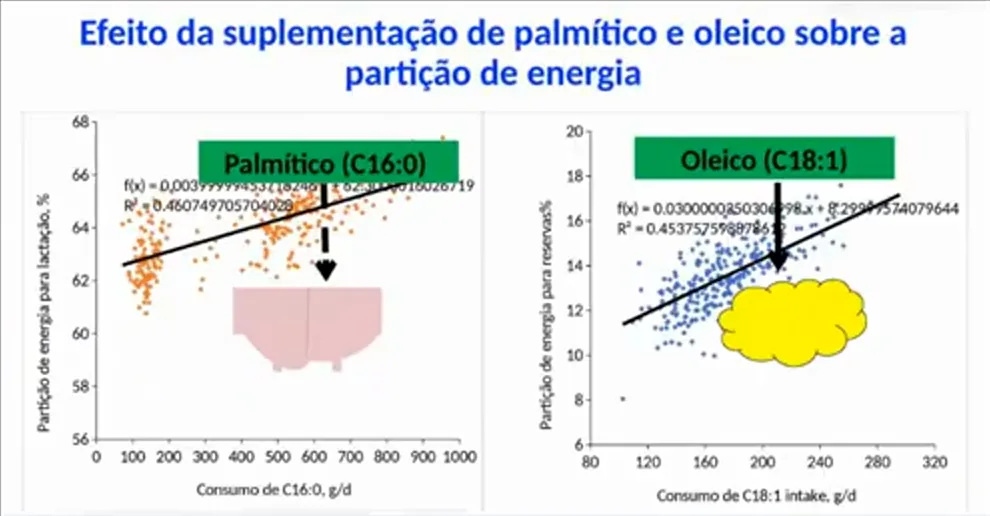
- Palmitic: the main fatty acid in milk; it improves milk fat yield and raised NDF digestibility by 3.2 units on average across six studies (for example, from 40% to 43%). It can induce insulin resistance.
- Oleic: improves fatty acid digestibility and insulin sensitivity, with better responses in high-producing and early-lactation cows.
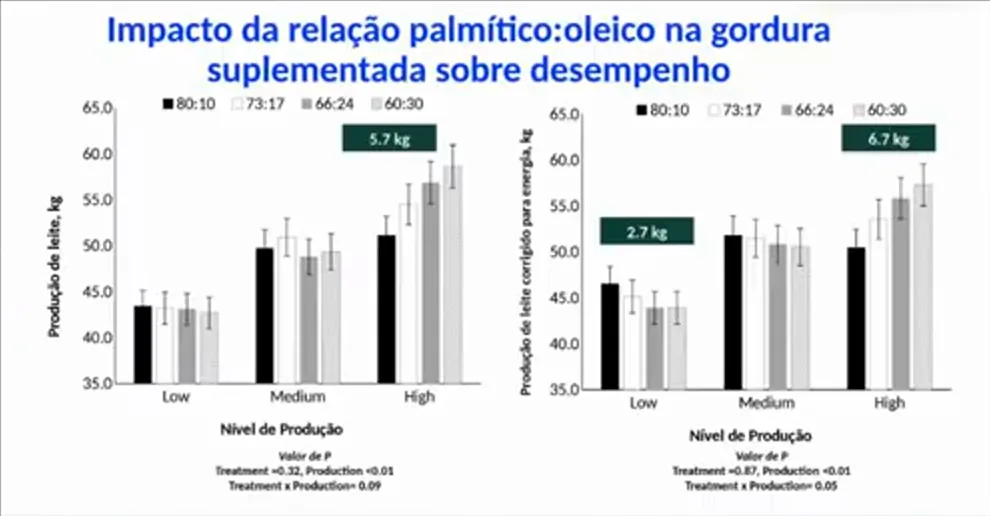
In cows producing 43, 50 and 56 kg of milk, fed the same diet with supplements ranging from 80:10 to 60:30 palmitic:oleic, low producers did not respond. In the high group, each step up in oleic raised milk linearly, with no change in intake (about 29 kg DM) and a trend toward more body weight gain.
After calving (56 cows, fat at 1.5% of DM from 1 to 24 DIM; de Souza et al., 2021), a palmitic-only supplement increased weight loss. With more oleic, cows ate more, lost less body condition, and caught up in milk by the second week. In another study, fat (0, 1% and 2% of DM, 60:30 ratio) added +1.4 kg of milk/cow/day as the response to FA supplementation (0, 1% and 2% of DM), on top of the metabolizable protein effect and left a carryover effect of almost 2 kg after it was removed (Parales-Girón et al. (2025), ADSA abstract).
When supplementation pays
- On a TMR, cows below 30 kg: generally not indicated.
- On a TMR, 30 to 40 kg: depends on the goal and the cost.
- On a TMR, above 45 to 50 kg: often needed to balance the diet without sacrificing body condition and reproduction.
- Pasture exception: cows peaking at 26 to 30 kg gained 3 to 4 kg at peak with supplementation, and fat allows less starch in the concentrate.
Before buying, Jonas suggests three questions: what is the goal (energy, body condition, milk or components), what the basal diet already supplies, and whether the product has data and consistency behind it. Also ask the supplier for the fatty acid profile, the total fatty acid content and the form the fatty acids are in. Digestibility of palmitic supplements ranges from about 30% to 70% depending on raw material and process, and no lab test tells a good one from a bad one; that is why Jonas recommends products proven in feeding trials. (Jonas de Souza, 2026.)
Fat does not fix other problems. Milk fat depression from excess oil, starch above 30% or a lack of long fiber has to be fixed in the diet. See how to assess physically effective fiber and the Penn State separator ranges for the TMR.
What milk and reproduction tell you (Hutjens, 2026)
- Origin of milk fat: de novo 18% to 30%, mixed 35% to 40%, preformed 30% to 45%.
- According to Dr. Mike Hutjens, 5 to 10 g of CLA, mainly the trans-10, cis-12 isomer, can cause a reduction of approximately 0.5 point in milk fat (from 4.0% to 3.5%).
- A protein:fat ratio above 0.90 in Holsteins means milk fat is short. If more than 10% of the herd has protein 0.4 point above fat, investigate rumen acidosis.
- A protein:fat ratio below 0.75 means milk protein is short: low microbial protein or not enough rumen-undegradable protein.
- With palm oil, preformed fatty acids can exceed 40% of milk fat. Strong heat also drops bulk-tank fat.
- Fecal fat: the average was 2.5% in 2025 (1,380 samples) and 3.5% in 2026 (631 samples, Rock River Labs), with about 67.7% fat digestibility. A result above 5% calls for checking the source, the amount or the particle size of the supplement. NIR analysis costs about US$ 32.25 in the U.S.
- Low milk fat? If long fiber is short, add 1 kg of hay or 0.5 kg of straw; if starch is above 30%, cut it.
- Omega-6:omega-3: a commercial recommendation cited by Hutjens suggests about 15:1 prepartum and 5:1 postpartum; Jonas notes that Silvestre et al. (2011) and Greco et al. (2015) point to about 4:1 after calving.
- A meta-analysis of 20 studies, cited by Hutjens, showed improved first-service conception with dietary fat.
Does your diet have the right fatty acids? The AI shows you.
In Ruminants.ai you import the diet and see which feeds contribute most to saturated, monounsaturated and polyunsaturated fatty acids, so you can adjust the formulation in minutes. Create your free account.
Create a Ruminants.AI accountFAQ
What is the maximum fatty acid level in a dairy cow diet?
About 7% of DM. The basal diet already supplies 3%, and 5% may be ideal in early lactation.
Are calcium salts rumen-protected fat?
Not fully. Rumen dissociation ranges from 20% to 30% at pH 6.5 to 40% to 50% at pH 5.8 to 6.0.
Palmitic or oleic?
Palmitic favors milk fat; oleic favors digestibility and body reserves. High-producing and early-lactation cows respond better to blends with more oleic.
Should I supplement 25 kg cows?
On a TMR, below 30 kg it is generally not indicated. On pasture, with energy restriction, it can.
References
- Lock, A. L.; dos Santos Neto, J. M.; de Souza, J. 2025. Invited review: Moving from dietary fat to fatty acids. Journal of Dairy Science 108:11733–11756. DOI: 10.3168/jds.2025-27040
- de Souza, J.; St-Pierre, N. R.; Lock, A. L. 2019. Altering the ratio of dietary C16:0 and cis-9 C18:1 interacts with production level in dairy cows. Journal of Dairy Science 102:9842–9856. DOI: 10.3168/jds.2019-16374
- de Souza, J.; Prom, C. M.; Lock, A. L. 2021. Altering the ratio of dietary palmitic and oleic acids affects production responses during the immediate postpartum and carryover periods in dairy cows. Journal of Dairy Science 104:2896–2909. DOI: 10.3168/jds.2020-19311
- Parales-Girón et al. (2025). ADSA abstract (palmitic:oleic supplement levels and metabolizable protein in early lactation).
- de Souza, J. Live class on dietary fatty acids (in Portuguese). Santafé Agroinstituto, 2026.
- Hutjens, M. How to use fat and fatty acids for more milk and efficiency. Webinar, Ruminants.ai
- Nutrient Requirements of Dairy Cattle, 8th revised ed. — Santafé edition.