
Penn State Separator series · Mixing
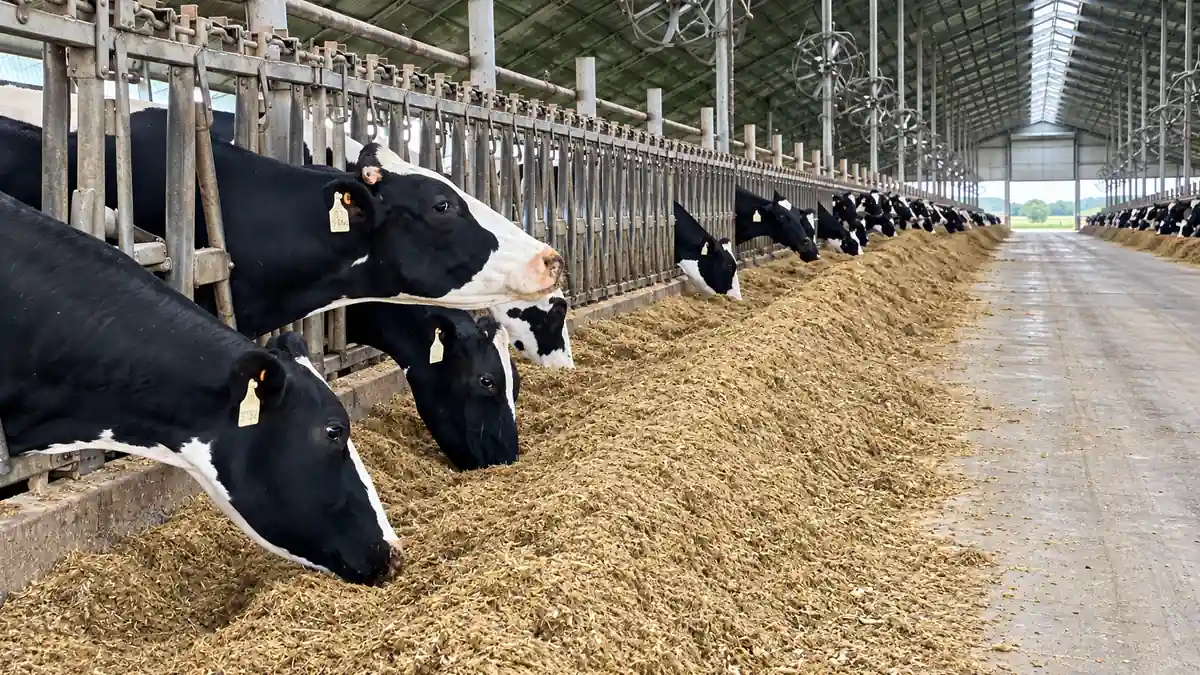
The TMR mixer wagon weighs, cuts, mixes, transports and delivers the TMR, and the goal is for every portion in the bunk to carry similar proportions of forages, concentrates, minerals, vitamins and additives. That reduces sorting and nutrient variation (Nutrient Requirements of Dairy Cattle, 8th revised ed. — Santafé edition). To find out whether your mixer is doing its job, sample the start, middle and end of the unload with the Penn State Particle Separator and compare the fractions.
Content source: this article was built from answers given by the Ruminants.ai app on TMR mixer wagons, based on the references listed at the end. It is part of the Penn State Separator series, which starts with the reference ranges your TMR should follow.
Types of TMR mixer wagon
In the Dairy Cow Management and Nutrition course (module 43, lesson 1), Dr. Mike Hutjens presents the main types and the approximate share of each in the US:
| Type | Features | US share |
|---|---|---|
| Vertical | 1 to 3 conical augers; processes hay and long forage | ~37% (most common) |
| Reel | – | ~16% |
| Horizontal | 1 to 4 augers; works best with pre-processed hay | ~8% |
| Tumble | Stationary | ~1.5% |
| Mixer cart | Small herds, tie-stall barns | – |
As for setup, a mixer can be pull-type, truck-mounted or stationary. A stationary unit works as a mixing center and, in large herds, cuts shrink and gives more accurate weighing.
How to choose
Weigh up herd size, ingredient type and moisture, whether long forage is in the ration, equipment capacity and the dairy’s logistics.
In practice, if the ration includes long hay or straw, it makes sense to choose equipment that can process long forage, such as a vertical mixer; a horizontal mixer works best with pre-processed hay. In large herds, a stationary mixing center helps cut shrink and weigh more accurately. For small tie-stall herds, the mixer cart is the option mentioned.
The two operating mistakes
- Undermixing: the TMR ends up uneven along the bunk.
- Overmixing: reduces particle size and physically effective fiber.
(Serva et al., 2021; Piran Filho, 2022.) Loading order, fill level, mixing time, knife wear and moisture all affect uniformity (Serva et al., 2021).
A mixing routine that works
Dr. Mike Hutjens’ recommendations (module 42, lesson 2) are straightforward:
- run the mixer at 75–80% of capacity;
- mix for 3 to 6 minutes after the last ingredient;
- use scales accurate to ±0.25%;
- keep a magnet at the discharge.
Suggested loading order (module 43):
- forages to be processed (hay, straw);
- dry grains;
- mineral and vitamin premix (at least 2 kg);
- wet byproducts;
- silages;
- liquids.
Long hay pre-processed to less than 25 cm reduces sorting. The general logic: light, long ingredients first, dense ones later (Schingoethe, 2017).
Quality control: in TMR audits, aim for a CV below 5%. The 1-2-3 rule sets the tolerance between samples: ±1 point of CP, ±2 of ADF and ±3 of DM.
How to use the separator to check the mixer
After unloading, collect samples at the start, middle and end of the bunk and run each one through the separator. If the fractions differ a lot from one another, the mix is uneven: review loading order, fill level, mixing time and knives.
Always repeat the test the same way. That way, a worn knife or a change in loading order shows up on the separator before it shows up in the bulk tank.
Also compare each sample with the TMR reference ranges (Grant, 2026: 19 mm 2–5%, 8 mm >50%, 4 mm 10–20%, pan 25–30%). Use the free calculator in the main article to convert the weights. If the mix looks good and there is still long forage left over, the next step is to look into TMR sorting.
Bring the Penn State separator to your dairy
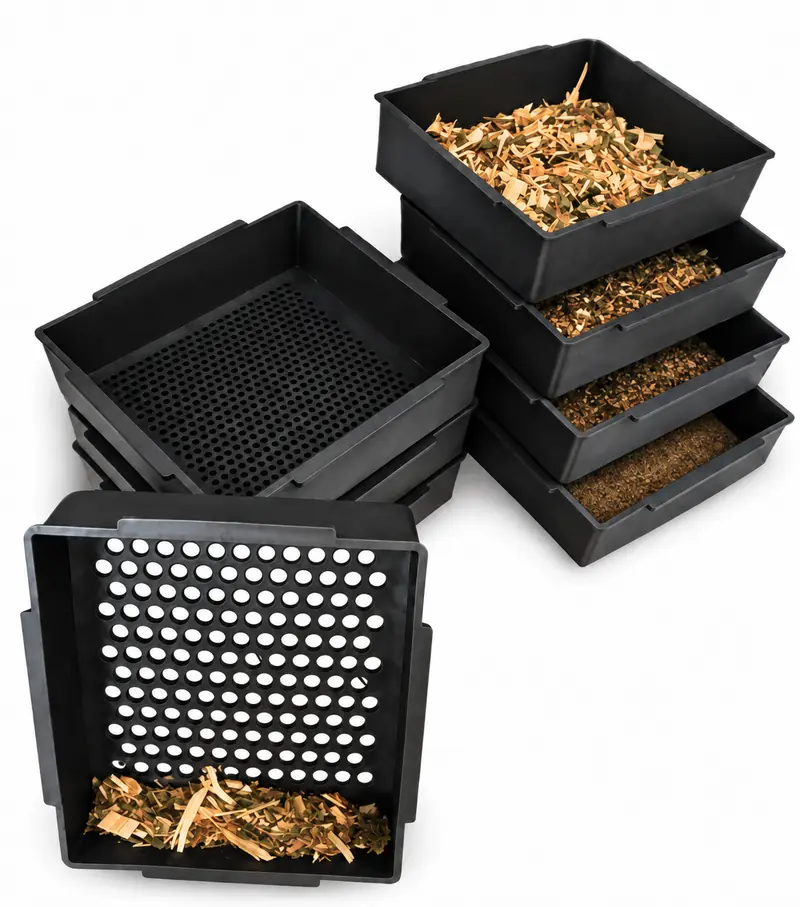
Penn State Particle Separator
3 sieves (19 / 8 / 4 mm) + closed pan · fiber-reinforced polypropylene
Get my sieve setYour separator measures. The AI interprets.
This content grew out of questions asked to Ruminants.ai. Create your account, enter the weights of the start, middle and end-of-bunk samples and get the percentages plus a reading of where the mix may be going wrong.
Create your Ruminants.AI accountFrequently asked questions
How long should I mix the TMR?
3 to 6 minutes after the last ingredient. Overmixing reduces particle size and effective fiber.
Can I fill the mixer to the top?
The recommendation is to run it at 75–80% of capacity.
How do I know if the mix is uniform?
Run samples from the start, middle and end of the bunk through the separator. If the fractions differ a lot, the mix is uneven.
Keep reading the series: physically effective fiber and TMR sorting.
References
- Grant (2026). Penn State Particle Separator reference ranges for TMR (% as-fed). Presented in Dr. Mike Hutjens’ class.
- Hutjens, M. Dairy Cow Management and Nutrition course, modules 42 and 43. Santafé Agroinstituto.
- Piran Filho, F. A. 2022. PhD thesis, UEM (Brazil).
- Schingoethe 2017. Journal of Dairy Science. DOI: 10.3168/jds.2017-12967
- Serva, L. et al. 2021. Animals. DOI: 10.3390/ani11123566
- Nutrient Requirements of Dairy Cattle, 8th revised ed. — Santafé edition.